Royal Siblings Entrepreneurs Club
Export Readiness: The CEO Challenge
An Executive Simulation Strategic Assessment
Welcome, Leader. Moving an enterprise from local market dominance to global execution is an intricate art form. Trial-and-error operations cost millions.
This enhanced simulation tests your execution capabilities on core Nigerian statutory compliance pipelines, global quality benchmarks, cross-border metrics, and trade finance.
Module 1: Compliance Mastery — Stage 1 of 6
European Regulatory Barriers
Scenario:
Your first major bulk shipment of premium agro-processed consumer goods arrives at an EU port of entry. Customs officials flag your cargo, noting an absence of harmonized sanitary and phytosanitary (SPS) compliance verification patterns alongside unvetted quality marks. As CEO, how do you insulate your enterprise from a total border rejection and immediate cargo seizure?
Module 2: Statutory Integrity — Stage 2 of 6
Trade Compliance Pipelines
Scenario:
Your financial team prepares an outbound container deal matrix. To legitimately access structural export incentives and safeguard international revenue repatriation corridors, local central bank trade compliance frameworks must be executed precisely. Which mandatory regulatory framework combinations are required before booking ocean freight?
Module 3: Nigerian Logistics Execution — Stage 3 of 6
Port Operations Gridlock
Scenario:
Your shipment is heading out via Apapa Port. To prevent extortionate demurrage, avoid container abandonment, and pass inspection checkpoints smoothly by Nigeria Customs Service (NCS) and Pre-Shipment Inspection Agents (PIAs), you must maintain pristine procedural documentation. Which operational path eliminates gridlocks and regulatory delays before your containers enter the port gate?
Module 4: Financial Protection — Stage 4 of 6
Incoterm Asset Protection
Scenario:
A global buyer requests pricing structures to take control of cargo immediately upon its departure from your warehouse doors. The buyer demands you assume financial liability and costs while the ship crosses open waters, yet proposes an incompatible standard shipping term. To explicitly lock down clear cutoffs for financial risk, transport liabilities, and commercial pricing, which international Incoterm selection serves your factory gate exit goal?
Module 5: FX Compliance & Repatriation — Stage 5 of 6
Currency Liquidation Windows
Scenario:
Your export proceeds land in your corporate Domiciliary Account. Central Bank of Nigeria (CBN) regulations stipulate strict rules on the handling and liquidation of non-oil export proceeds. How must you utilize these foreign exchange inflows to preserve operational legality and avoid severe banking blacklists?
Module 6: Strategic Growth — Stage 6 of 6
Institutional Scaling Frameworks
Scenario:
Your enterprise experiences rapid, unpredicted inbound international requests. Relying on trial-and-error localized execution threatens to drain capital allocations and bottleneck working capital chains. What scaling path ensures sustainable global market penetration and shields your corporate foundation?
Simulation Evaluation Completed
Your Executive Matrix Profile
Strategic Risk Assessment Score
0 / 150
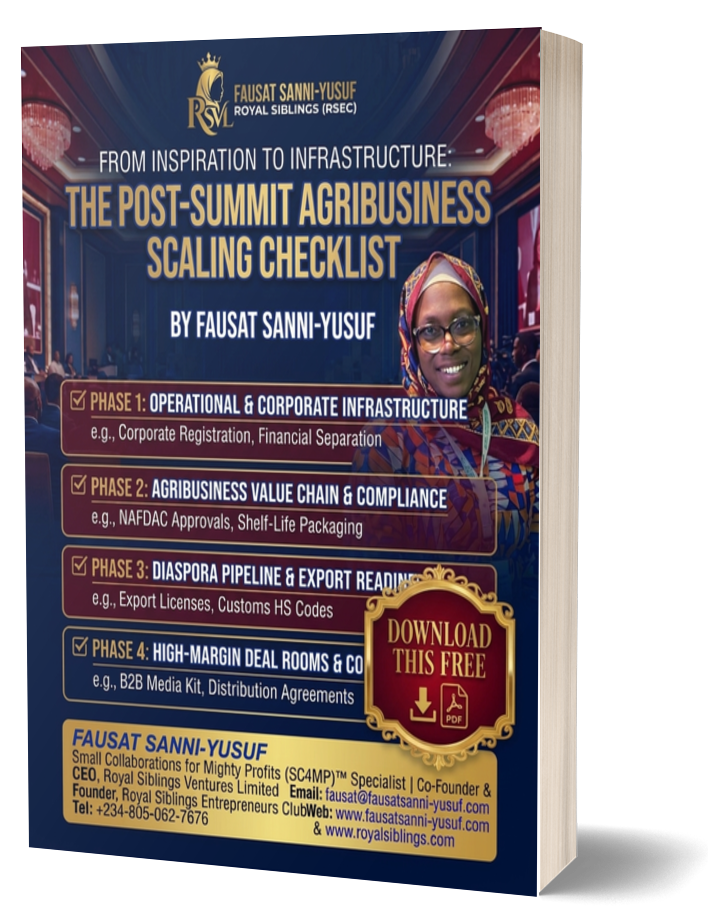
DOWNLOAD THIS FREE PDF WHITE PAPER
TITLE = Secure Your Strategy Session & Download This PDF Report FREE
(From Inspiration to Infrastructure: The Post-Summit Agribusiness Scaling Checklist):